

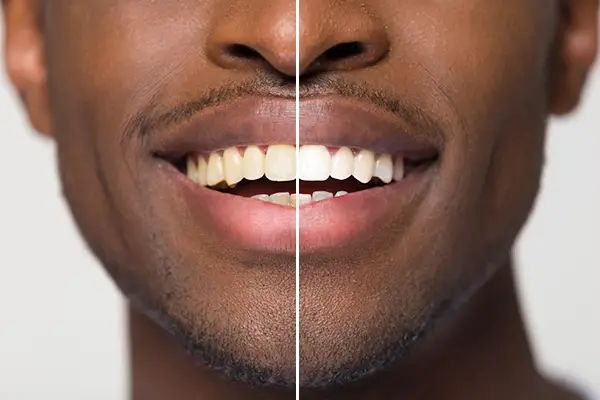
When people say they want “whiter teeth,” they often don’t realize there are two very different ways to get there: whitening and masking. They may look similar at first glance, but biologically and aesthetically, they’re not the same at all.
Teeth whitening works by lightening your natural tooth structure. Whitening agents penetrate the enamel and break down internal stains caused by things like tea, coffee, wine, smoking, or natural ageing. The tooth itself becomes lighter. Nothing is added to the surface, and the shape of the tooth stays exactly the same. When done properly, whitening preserves the integrity and translucency of natural teeth, which is what gives a healthy smile its depth and life.
Masking, on the other hand, doesn’t change the colour of the tooth underneath. Instead, it covers it up. This includes veneers, crowns, bonding, or cosmetic composites. The darker tooth remains the same, but a lighter material is placed over it to hide the colour. Masking can be very useful when teeth are badly damaged, heavily stained from medication, or structurally weak—but it is still a cover, not a colour change.
The key difference is this:
Whitening enhances what you already have. Masking replaces or hides it.
Another important distinction is subtlety. Naturally whitened teeth reflect light differently from masked teeth. They tend to look more alive, more individual, and less uniform. Masked teeth can look beautiful when done well, but they require more intervention, more maintenance over time, and are not always reversible.
In simple terms, if your teeth are healthy and you’re looking for a brighter, fresher smile, whitening is usually the first and most conservative option. Masking is a restorative solution, not a shortcut to whitening.
At Gentle Dental, we will always ask why your teeth are discoloured before recommending how to change them—and will choose preservation over cover whenever possible.
